There is a long history of use of precious stones as industrial materials, from precision bearings to cutting tools, lapping compounds to grinding tools and several other specialised applications.
The recording of phonograph records is essentially a machining operation, performed by means of a machine tool called a disk recording lathe. A special cutting tool is used to cut a continuous spiral groove on the surface of a blank disk. This tool is called a disk recording stylus, or simply cutting stylus. The big difference to other forms of machining is that there is sonic information stored as modulation of the cut groove, which can be reproduced on another special machine, often called turntable or record player, or disk reproduction system.
In the previous episode, we had a look at taper shank stylus adapters and saw a vintage magnetic monophonic cutter head fitted to the AM44 lathe. The two are not normally compatible. Neumann lathe suspensions do not have the same mount as the suspensions of Presto, Fairchild, RCA and other lathes of the monophonic era, which were originally designed to accept such cutter heads.
But, in fact, almost any cutter head can be fitted to any lathe, as long as there is enough space for it to physically fit, by means of a suitable adapter. The eagle-eyed reader will probably have noticed that the cutter head mount on our prototype AM44 suspension is similar to, but not the same as, the mount used in Neumann suspension boxes. So, the adapter shown here was made specifically for our AM44 suspension unit.
Stereophonic cutter heads developed by Neumann are designed to accept a cutting stylus with a conical shank, resembling a micro-miniature version of a Morse Taper, a type of fitting frequently encountered in machine tools, especially metalworking lathes. Vinylium and FloKaSon cutter heads also adopted the same fitting for the sake of compatibility. But most other cutter heads, especially all those predating the stereophonic era, used long, thin cylindrical shanks, often with a flat machined on one side, to allow a set-screw to align the stylus and secure it in place.
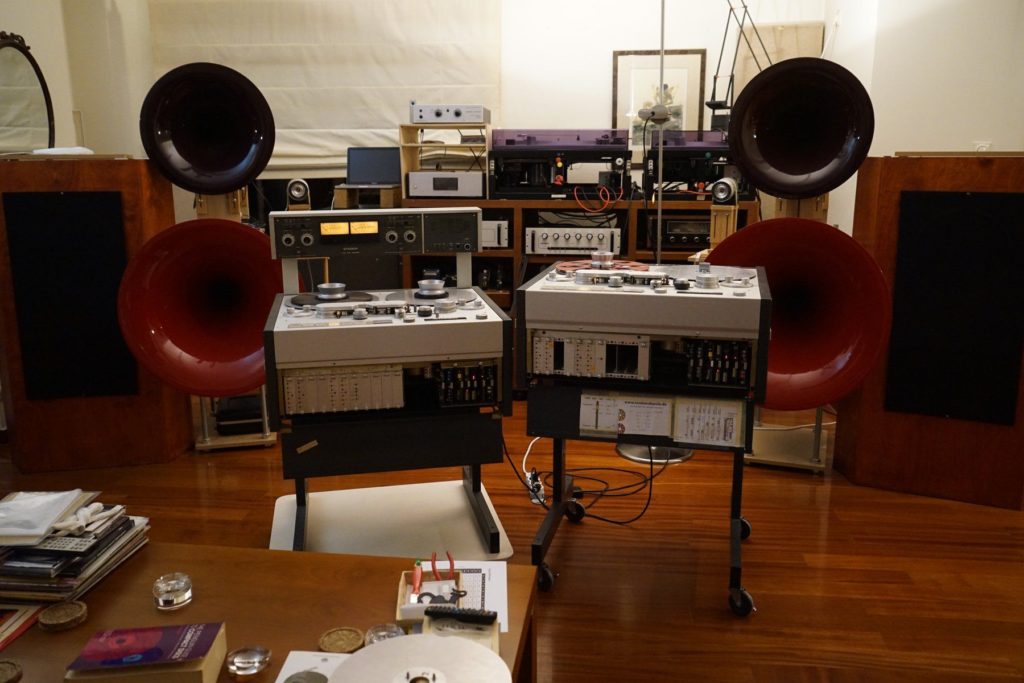
Meet George Vardis, a retired biologist with a Master's Degree in Food Technology, residing in Athens, Greece. George is a sophisticated man with many interests, including sailing, photography, motorbikes, and music. He plays the piano and the guitar, but his career always steered well clear of the music industry. He was never a recording artist, nor was he a recording engineer. In fact, he has probably never seen a recording studio in real life.